Manage Cookie Preferences

To understand how people use our site and improve your experience on our website, we use cookies. Please choose which types of cookies you’re happy with – you can change your selection at any time. To learn more, read our Cookie Policy.

Retirement

Can I draw my private pension at 55 and still work?

Written by Luke Johnston-Bolton on 13th January 2026 Time to read: 7 minutes

A guide to flexible retirement

Planning for your future doesn’t always mean a hard stop to your career. One option people choose is to ease into retirement by reducing their hours or finding a new role while starting to access their pension. This leads to one of our most frequently asked questions: ‘Can I draw my pension and still work?’

For most people with private pensions, the answer is yes. Thanks to modern pension freedoms, you have more flexibility than ever before. You can access your savings to supplement your income, tick items off your bucket list or simply enjoy a bit more financial freedom.

However, while it is possible, it’s a big decision with important rules and tax implications that you need to understand first. This guide will walk you through what you need to know.

At what age can I start drawing my pension?

You can normally start taking money from your private or workplace pension from the age of 55. This includes most defined contribution schemes.

It is crucial to know that this age is rising. From 6th April 2028, the minimum pension age will increase to 57 If you are planning to access your pension in the next few years, you must factor this change into your timeline. It would be beneficial for those who will be aged between 55 and 57 when the rules change to seek advice from a financial adviser.

This rule applies to private pensions only and should not be confused with your State Pension age, which is set by the government and is currently 66 for both men and women, albeit also set to rise.

Key considerations before you draw your pension and continue working

Taking money from your pension pot while still earning a salary is a significant financial step. Before you move forward, it’s essential to do your homework. Here are three of the most important things to consider.

How your pension withdrawal is taxed

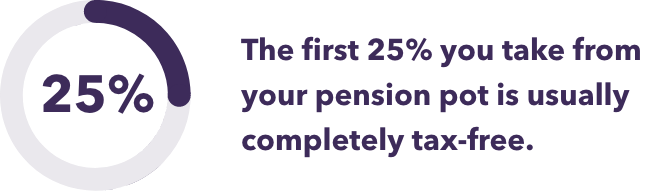
The first 25% you take from your pension pot is usually completely tax-free (some individuals may have higher allowances from a time when previous rules were in force. If you’re unsure, check with your financial adviser). You can take this as a single lump sum or as smaller amounts. These options will work differently for different people, depending on a whole range of circumstances and factors.

However, the remaining 75% is treated as taxable income, in the same way as your salary. When you take this money, it is added to your other income for the year. This is a critical point to remember, as the combined total of your pension withdrawal and your salary could potentially push you into a higher income tax bracket (the 40% higher rate or 45% additional rate). This could mean you pay much more tax than you were expecting.

The Money Purchase Annual Allowance (MPAA)

This is one of the most important but least understood rules. The Money Purchase Annual Allowance, or MPAA, significantly limits how much you can save into a pension before you pay tax.

Normally, you can save up to £60,000 a year, or 100% of your relevant UK earnings (whichever is lower), into your pensions while receiving tax relief. However, this can change dramatically once you start flexibly taking taxable income from your defined contribution pension pot.

Doing so usually triggers the MPAA. This permanently reduces your annual allowance from £60,000 to just £10,000 a year. Understanding what actions trigger this rule is essential if you plan to continue working and saving.

When the MPAA is usually triggered

  • Taking a flexible lump sum: You start to take cash lump sums from your pension pot (where 25% of each withdrawal is tax-free and the other 75% is taxed).
  • Drawing a flexible income: You move your pension savings into a ‘flexi-access drawdown’ fund and begin to take an income from it.
  • Buying a flexible annuity: You use your pot to buy an annuity (an insurance product that pays an income) that allows the amount you receive to change.

What does NOT trigger the MPAA

  • Taking only your tax-free cash: You take only the 25% tax-free lump sum from your pension and leave the rest of your pot untouched.
  • Buying a lifetime annuity: You use your entire pension pot to buy a conventional lifetime annuity that provides a guaranteed income for life.
  • Cashing in a small pot: You cash in one or more small pension pots that are each valued at less than £10,000. There are rules and limits to this option, however, so please make sure you speak to a financial adviser.
  • Take money from a defined benefit pension: The allowance only applies to private pensions, the vast majority of which are defined contribution schemes.

The impact on your long-term savings

Your pension pot is designed to support you for the rest of your life. By taking money out of it early, you reduce the amount left to grow for your full retirement. This means you will have a smaller pot to provide an income when you eventually stop working for good.

It’s vital to calculate whether your remaining savings will be enough to last throughout a retirement that could span 20, 30 or even more years.


The advantages and disadvantages of working while drawing a pension

To help you decide if it’s the right move for you, here is a balanced look at the pros and cons of drawing a pension and continuing to work.

Advantages

  • Supplement your income: Use your pension to top up your salary, allowing you to afford a better lifestyle.
  • Reduce your hours: It can give you the financial freedom to go part-time or take on a less demanding role.
  • Fund a project: Access your 25% tax-free cash for big plans like home renovations, a new car or helping family.
  • Ease into retirement: It allows for a gradual transition from working life to full retirement, which many people prefer.

Disadvantages

  • You may face a large tax bill: Your combined income could push you into a higher tax bracket.
  • You could trigger the MPAA: This will restrict your ability to rebuild your pension savings in the future.
  • Your pension pot will be smaller: You are reducing the funds available to you for later life.
  • You lose out on future growth: The money you withdraw can no longer benefit from tax-free investment growth inside the pension.

When to seek financial advice

Deciding whether you can draw your private pension and still work generally means thinking about far beyond the immediate benefits and consequences. This is where professional advice becomes invaluable.

A financial adviser can create a personalised forecast for your retirement, showing you how different scenarios might play out. They can help you navigate the complex tax rules and find the most efficient way to access your money without falling into common traps like the MPAA.

Our expert advisers can help you build a plan that works for you.

Take the next step in your retirement journey

Understanding your options is the first step towards a confident and secure future. If you are considering accessing your pension while you continue to work, speaking to an expert can make all the difference.

Contact us today to arrange a no-obligation consultation with a qualified financial adviser.

With investing, your capital is at risk. Investments can fluctuate in value and you may get back less than you invest. This material is not a personal recommendation or financial advice and the investments referred to may not be suitable for all investors.

Tax is subject to an individual’s personal circumstances, and tax rules can change at any time. This article is not personal financial advice.

Past performance is not a guide to future performance.

Pension eligibility and tax rules apply. You should ensure your contribution does not result in your total Pension contribution within the tax year exceeding £60,000 or 100% of your earnings, whichever is lower.

True Potential Wealth Management is authorised and regulated by the Financial Conduct Authority. FRN 529810. Registered in England and Wales as a Limited Liability Partnership No. OC356611.

True Potential Investments LLP is authorised and regulated by the Financial Conduct Authority. FRN 527444. Registered in England and Wales as a Limited Liability Partnership No. OC356027.

True Potential LLP is registered in England and Wales as a Limited Liability Partnership No. OC380771.

Tell us your financial goals and we could help you achieve them.

Find out more

Capital at risk.

You may also like

Market update: What’s shaping the global outlook?

Markets & Insights

Market update: What’s shaping the global outlook?

2025 year in review

Markets & Insights

2025 year in review

The importance of tax wrappers and how to use them

Tax & Inheritance

The importance of tax wrappers and how to use them

Brought to you by True Potential Wealth Management.

True Potential Wealth Management offers restricted financial advice. Our service is specifically designed for clients wishing to access their financial affairs online.

With investing your capital is at risk. Investments can fluctuate in value and you could get back less than you invest.

Tax is subject to an individual’s personal circumstances, and tax rules can change at any time.

True Potential Wealth Management LLP is authorised and regulated by the Financial Conduct Authority, FRN 529810. www.fca.org.uk

Registered in England and Wales as a Limited Liability Partnership No. OC356611.

Our website uses cookies to help personalise your experience with True Potential. By clicking "Accept all", you consent to our use of cookies. You can choose to control which cookies we use at any time, by clicking "Manage Preferences". If you choose not to accept some cookies, please note you may experience more limited functionality on our website. To learn more, read our Privacy notice.